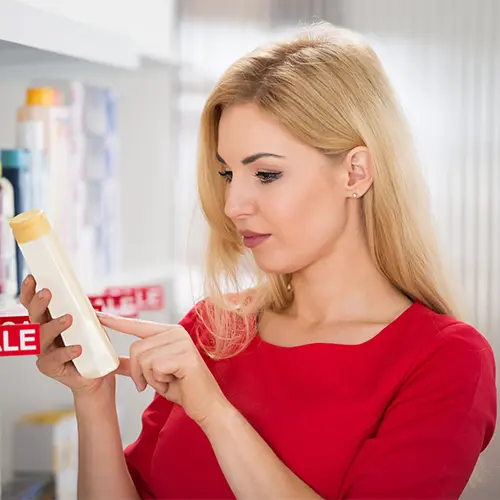
The front of a bottle is marketing. The back is where the facts are. Every cosmetic sold in stores in the U.S. has to list its ingredients, and once you know a few rules, that small print tells you a lot. Here’s how to read it.
1. The order tells you how much
Ingredients are listed from most to least. The first three to five usually make up most of the product, and in lotions and shampoos the first is almost always water (often written “aqua”).
There are two catches. Anything at 1 percent or less can be listed in any order after the bigger ingredients, so the second half of a long list doesn’t tell you much about amounts. Color additives can come last in any order. In makeup sold in several shades, you’ll often see them after “may contain” or “+/-.”
2. Learn the naming system
Labels use standardized international names (INCI), which is why familiar things look strange:
- Aqua: water
- Parfum: fragrance
- Tocopherol: vitamin E
- Butyrospermum parkii: shea butter
- Sodium chloride: table salt
A long chemical name isn’t automatically bad, and a plant name isn’t automatically safe. Look ingredients up rather than judging by how they sound.
3. “Fragrance” is a black box
U.S. rules let companies list a scent blend as just “fragrance” or “parfum,” without naming what’s in it. One word can stand for dozens of chemicals, including known allergens and, in some products, phthalates used to make scents last. In 2022 Congress told the FDA to require labeling of fragrance allergens, but that rule still isn’t in effect.
If you have sensitive skin or allergies, “fragrance-free” products are the simplest way to avoid the problem. Note that “unscented” can mean a masking fragrance was added. See our Fragrance/Parfum profile.
4. Know the ingredients worth a second look
These come up again and again in our database:
- Parabens (methylparaben, propylparaben, butylparaben): preservatives that can mimic estrogen. Read the profile.
- Formaldehyde releasers (DMDM hydantoin, quaternium-15, imidazolidinyl urea, diazolidinyl urea, bronopol): preservatives that slowly release formaldehyde. Read about formaldehyde.
- Sulfates (sodium lauryl sulfate, sodium laureth sulfate): harsh foaming agents that can irritate skin. Read the profile.
- Triclosan: an antibacterial agent the FDA banned from antibacterial hand and body soaps in 2016, but still allowed in some other products. Read the profile.
- “Fluoro” ingredients and PTFE: signs of PFAS, the “forever chemicals.”
5. Some products have a “Drug Facts” box instead
Sunscreens, antiperspirants, dandruff shampoos and acne treatments are regulated as over-the-counter drugs. Their labels list active ingredients first, with percentages, then inactive ingredients. Read both: the inactive list is where fragrance and preservatives show up.
6. Ignore most of the front of the bottle
Words like “natural,” “clean,” “non-toxic” and “hypoallergenic” have no legal definition for cosmetics. A company can use them without meeting any standard. Seals from independent certifiers mean more. For example, the USDA Organic seal requires the product’s agricultural ingredients to meet federal organic standards. Our own ToxicFree Certification vets products for harmful ingredients.
The shortcut
You don’t have to memorize any of this. Copy the ingredient list from a product (or its website) and paste it into our label checker. It matches each ingredient against our database and shows its rating, from Green Light to Red Light, in seconds.